If you’ve landed on this comparison, you already know the general category: a gift basket loaded with cheese, cured meats, crackers, and accompaniments, packaged to arrive at someone’s door looking impressive and tasting better than a gas-station snack plate. What you may not know yet is how wildly these baskets differ beneath the lid. Affinage — the French term for the process of aging and finishing a cheese to develop its flavor — is one of the factors that separates a block of processed “cheese food” from a wedge of cave-aged cheddar. It matters because a basket built around properly aged cheese tells a different story (and delivers a different experience) than one built around shelf-stable cheese analogues. Harry & David, Hickory Farms, and Wisconsin Cheese Company are three brands that dominate the $35–$100 search results for cheese gift baskets. They are not interchangeable. This article maps the spec-by-spec differences so you can buy the right one for the right moment — or make the case to a client or boss for why one outperforms the others at a given price point.
| EDITOR'S PICKHarry & David Ultimate Meat And… | Mid-tier[Hickory Farms Signature Beef Me…](https://www.amazon.com/dp/B071GCYG42?tag=greenflower20-20) | Budget pick[Wisconsin Cheese Company - Clas…](https://www.amazon.com/dp/B0994V3KXV?tag=greenflower20-20) | |
|---|---|---|---|
| Cheese types | 4 blocks | — | Cheddar & Pepper Jack |
| Sausage items | 4 sausages | Summer Sausage | Sausage |
| Crackers | 5 sets | — | — |
| Additional items | Sticks, Relish, Mustard | — | Pretzels & Mustard |
| Gift packaging | Gift Box | Box Set | Gift Box |
| Price | $143.98 | $44.99 | $44.99 |
| See on Amazon → | See on Amazon → | See on Amazon → |
What You’re Actually Comparing
Before the brand-by-brand breakdown, it helps to have a consistent evaluation framework. Reviewers at The Spruce Eats and Food & Wine both note that the most common disappointment in gift basket purchases is the gap between perceived value (how the basket photographs) and actual value (what you can eat, and how good it tastes). The evaluation dimensions that matter most:
- Edible-to-decorative ratio: What percentage of the basket’s weight and visual bulk is actually food you’d want to eat? Filler items — tissue paper, decorative tins, single-serve jam packets with two tablespoons of jam — inflate perceived value without adding to the eating experience.
- Cheese quality tier: Is the cheese processed (engineered for shelf stability, mild flavor, long shelf life) or natural (aged from whole milk, with a producer and region you can trace)?
- Meat sourcing: Commodity pepperoni and summer sausage are different products from small-batch salami or whole-muscle charcuterie. The difference shows in fat distribution, cure complexity, and finish.
- Shipped-weight-to-price ratio: Not the only metric, but a useful sanity check. You should be getting meaningful edible ounces per dollar.
- Shipping reliability for perishables: Cheese and cured meat are temperature-sensitive. A basket that arrives warm, sweaty, or late is a failed gift regardless of what’s inside.
Keep these five dimensions in mind as we move through the comparison.
Brand-by-Brand Breakdown
Harry & David
Harry & David has been in the gift-food business since the 1930s and is the name most gift-givers recognize on first instinct. Their cheese and charcuterie offerings — sold under the “Cheese and Charcuterie” and “Signature” collection naming — cluster in the $50–$120 range depending on basket size and seasonal configuration.
What’s inside: Harry & David’s cheese selections typically lean on branded proprietary items (their own labeled cheddars and cheese spreads) alongside recognizable commercial names like Tillamook. The Spruce Eats, in their roundup of best gift baskets, notes that Harry & David’s strength is presentation and brand polish rather than artisan sourcing. The cheeses are real dairy products, not processed cheese food, but they’re generally younger, milder, and less differentiated than what you’d find in a curated artisan basket. Meats are predominantly summer sausage and pepperoni in the commodity tier.
Edible ratio: Strong. Harry & David has worked to reduce decorative filler in recent seasons, and reviewers consistently report that most basket volume translates to actual food. The cracker and condiment selections — mustards, preserves — are generally above-average quality for the price tier.
Shipping reliability: This is where Harry & David earns genuine marks. Their logistics infrastructure, built over decades of peak-season perishable shipping, is among the most reliable in the category. Eater, in their overview of mail-order food sources, notes that Harry & David’s cold-chain management during holiday peaks outperforms most competitors at similar price points. If on-time delivery during November–December is a hard requirement, this matters.
The tradeoff: You’re paying a premium for brand recognition and logistics reliability, not for provenance or artisan depth. The cheese won’t generate conversation about its origin or aging program. For a recipient who will appreciate the brand name and the polished packaging, that’s a reasonable spend. For a recipient who will look at the producer label, it’s not the right pick.
Best fit: Reliable, low-risk gift for a broad professional or personal recipient list. Corporate bulk orders where consistent delivery matters more than artisan storytelling.
Hickory
$44.99
In stock on Amazon
Check price on AmazonHickory Farms
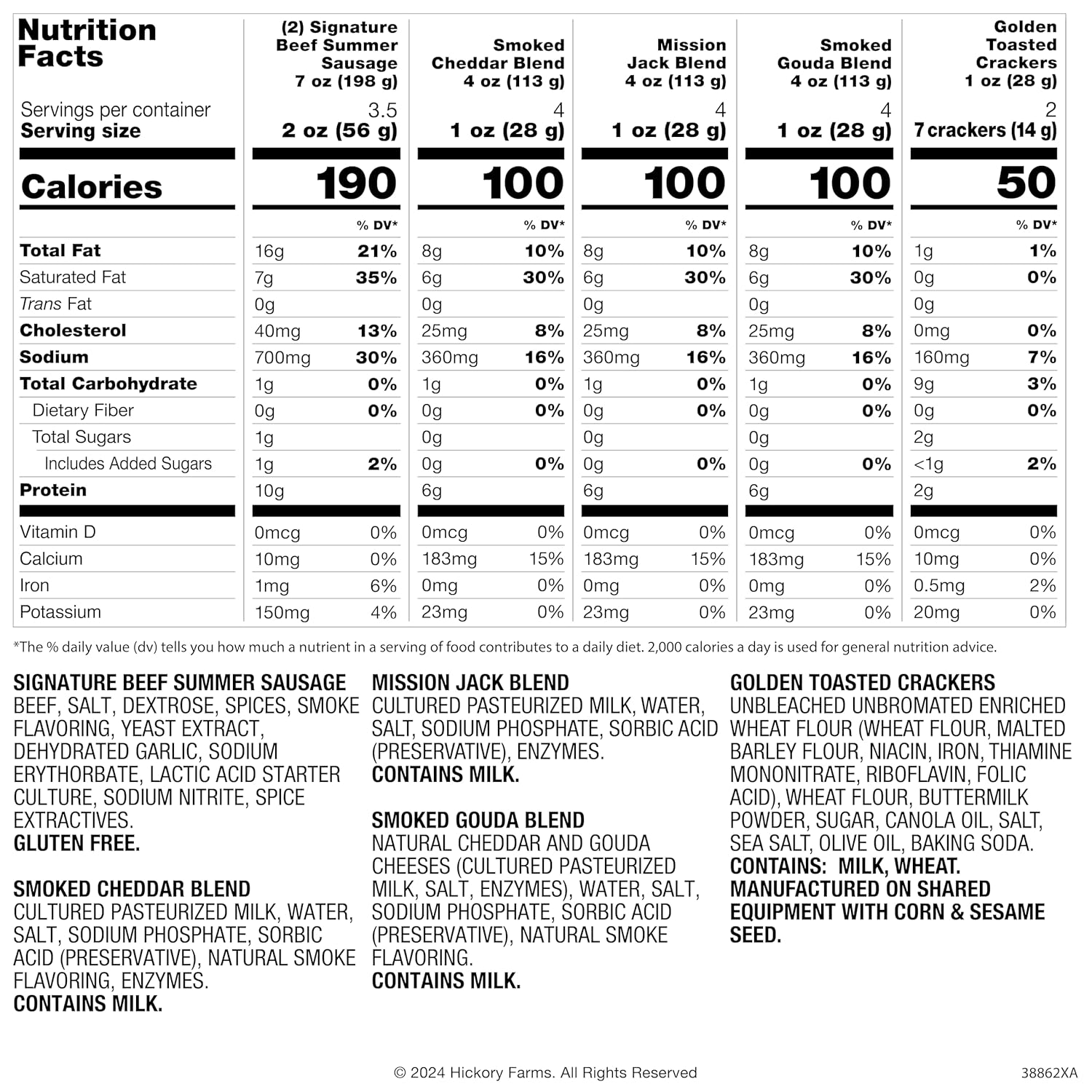
Hickory Farms is the category’s value-density champion, and there’s no shame in saying so clearly. Their $35–$65 baskets pack more edible ounces per dollar than either competitor in this comparison, and reviewers at The Spruce Eats consistently rate their summer sausage — the flagship product — as a genuinely good product, not a category compromise.
What’s inside: Hickory Farms built its reputation on summer sausage, and that heritage shows. Their beef summer sausage is a whole-muscle product with a clean smoke and spice profile that holds up favorably in side-by-side category comparisons. Food & Wine’s gift basket review noted the sausage as a standout in the entry price tier. The cheeses are processed or semi-processed — labeled as “cheese food” or “pasteurized process cheese” — which means they’re engineered for shelf stability and uniform melt rather than for flavor complexity. This is a real limitation for cheese-forward recipients.
Edible ratio: Excellent. Hickory Farms baskets are notably efficient. The brand’s core consumer value proposition is “a lot of food for the money,” and across aggregated reviews, the pattern confirms they deliver on that promise. You’re not buying much packaging theater here.
Shipping reliability: Hickory Farms products are shelf-stable by design, which sidesteps the cold-chain problem almost entirely. The processed cheese and cured sausage survive ambient shipping without quality loss. This is a genuine advantage for recipients in warm climates, extended delivery windows, or situations where you can’t guarantee the basket will be refrigerated promptly.
The tradeoff: The cheese is the weak point. If the person you’re gifting knows cheese — even casually — they’ll notice that the “cheddar” doesn’t taste like cheddar so much as it tastes like a processed dairy approximation. Serious Eats, in their overview of cheese gift sets, flags processed cheese as the most common disappointment in entry-tier baskets. The meat-first recipients will be happy. The cheese-first recipients will feel the gap.
Best fit: Meat-forward recipients, large-quantity gifting on tight per-unit budgets, situations where shelf stability matters — warm climates, long lead times, recipients without reliable refrigeration access.
Wisconsin
$44.99
In stock on Amazon
Check price on AmazonWisconsin Cheese Company
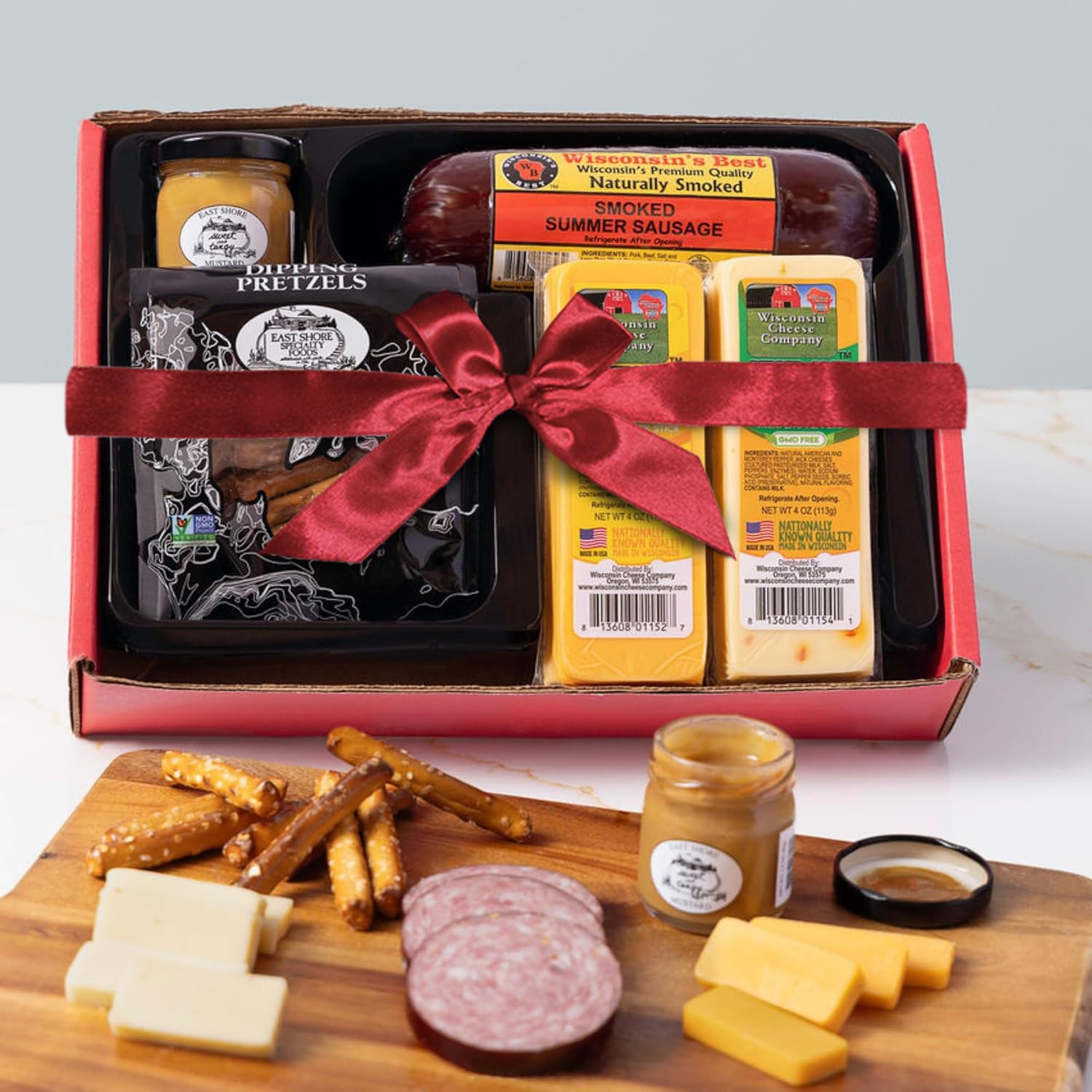
Wisconsin Cheese Company occupies an interesting position: price points that often overlap with Hickory Farms and Harry & David, but a sourcing model anchored in documented Wisconsin dairy production. Wisconsin is one of only two U.S. states with a Master Cheesemaker program — a certification requiring at least 10 years of licensed cheesemaking experience and advanced technical training — and Wisconsin Cheese Company leans into that provenance. Their producer sourcing standards, published via wisdairy.com in the Wisconsin Cheese Producer Sourcing Standards Documentation, specify natural-milk sourcing and aging requirements that distinguish the product from processed alternatives.
What’s inside: Natural cheese is the organizing principle here. Aged cheddars (typically 1–3 year), colby, pepper jack, and similar Wisconsin-style formats are sourced from in-state producers with traceable regional origins. Crackers and accompaniments tend toward functional rather than artisan — this is where the basket’s budget is focused on the cheese rather than the staging.
Edible ratio: Good, with a caveat. The packaging is less theatrical than Harry & David, which means some recipients will perceive it as “smaller” even when the edible weight is comparable. If packaging impression matters for your use case, manage that expectation upfront.
Shipping reliability: Natural cheese requires cold-chain management. Wisconsin Cheese Company uses insulated packaging and ice packs, and reviewers report generally reliable delivery in the $50–$90 price range during standard shipping windows. Peak-season reliability — Thanksgiving week through New Year’s — is less consistently documented than Harry & David’s, and this is worth factoring into holiday order timing.
The tradeoff: The meat selections are less compelling than Hickory Farms’ flagship sausage. If you’re building a basket for equal enthusiasm across cheese and charcuterie, Wisconsin Cheese Company wins on cheese but doesn’t close the gap on the meat side.
Best fit: Cheese-forward recipients, buyers who want to send something with a traceable story, and gifters upgrading from a first Hickory Farms or Harry & David purchase who want to demonstrate they’ve thought about what’s inside.
Harry
$143.98
In stock on Amazon
Check price on AmazonBy the Numbers
| Brand | Typical price range | Cheese type | Meat tier | Cold-chain required | Edible ratio |
|---|---|---|---|---|---|
| Harry & David | $50–$120 | Natural, commercial grade | Commodity | Yes | Strong |
| Hickory Farms | $35–$65 | Processed / cheese food | Better-than-commodity sausage | No | Excellent |
| Wisconsin Cheese Company | $45–$90 | Natural, regional provenance | Commodity | Yes | Good |
The Decision Rules
You’re not choosing the “best” basket in the abstract — you’re choosing the right basket for a specific recipient, occasion, and risk tolerance. Here’s how to map the decision:
If on-time delivery during peak season is the non-negotiable: Harry & David. Their logistics infrastructure is the most proven in this tier, and a basket that arrives on time in good condition beats a more interesting basket that arrives late or warm.
If budget is the binding constraint and the recipient is meat-forward: Hickory Farms. The value density is real, the summer sausage is genuinely good, and the shelf-stable format eliminates cold-chain failure risk entirely. Don’t apologize for this pick — it’s the honest one.
If the recipient knows cheese, or if you want the basket to communicate that you thought about provenance: Wisconsin Cheese Company. The natural aging story is there, the cheese quality gap over processed alternatives is meaningful, and at overlapping price points, this is where the product quality actually justifies the spend for a cheese-interested recipient. The Wisconsin Cheese Producer Sourcing Standards Documentation gives you specific language if you need to explain the pick to a client or colleague.
If you’re sourcing 10+ units for a professional occasion and need a consistent, recognized brand experience: Harry & David for the brand recognition play, or Wisconsin Cheese Company if you want to signal that your gifting program has a point of view about quality.
One honest note before you click through: all three of these brands live at the entry-to-mid range of the gift basket category. If the recipient is a serious food enthusiast, or if the occasion calls for the kind of basket that generates genuine conversation — the provenance of the affinage, the name of the creamery, the specifics of the aging program — the upgrade path runs through iGourmet, Murray’s Cheese, or Zingerman’s, where the sourcing documentation and artisan depth are built into the product rather than the packaging. Eater’s overview of mail-order cheese sources and Food & Wine’s tested-and-reviewed gift basket roundup both identify this upper tier as meaningfully distinct from the entry-to-mid segment covered here.
For most gifting occasions, though, the three brands in this comparison cover the decision space well. Know what matters for your specific send, and buy accordingly.