A meat-and-cheese gift basket is exactly what it sounds like: a curated collection of cured meats (salami, prosciutto, sausage) and cheeses (firm, soft, aged), usually accompanied by crackers, preserves, and the occasional dried fruit or chocolate, packed for shipping or in-person gifting. The category runs from a $35 grab-and-go tin at Hickory Farms to a $500-per-unit custom corporate program at Murray’s Cheese — and the gap between those two isn’t just price. It’s producer transparency, edible-to-filler ratio, aging pedigree (affinage — the French art and science of ripening cheese to peak flavor — is the word you’ll see on premium listings; now you know what it means), and whether the cheese inside was sourced from a named creamery or a commodity block. This guide maps four distinct price tiers, names the tradeoffs at each one, and ends with a clear decision rule so you can stop second-guessing and commit.
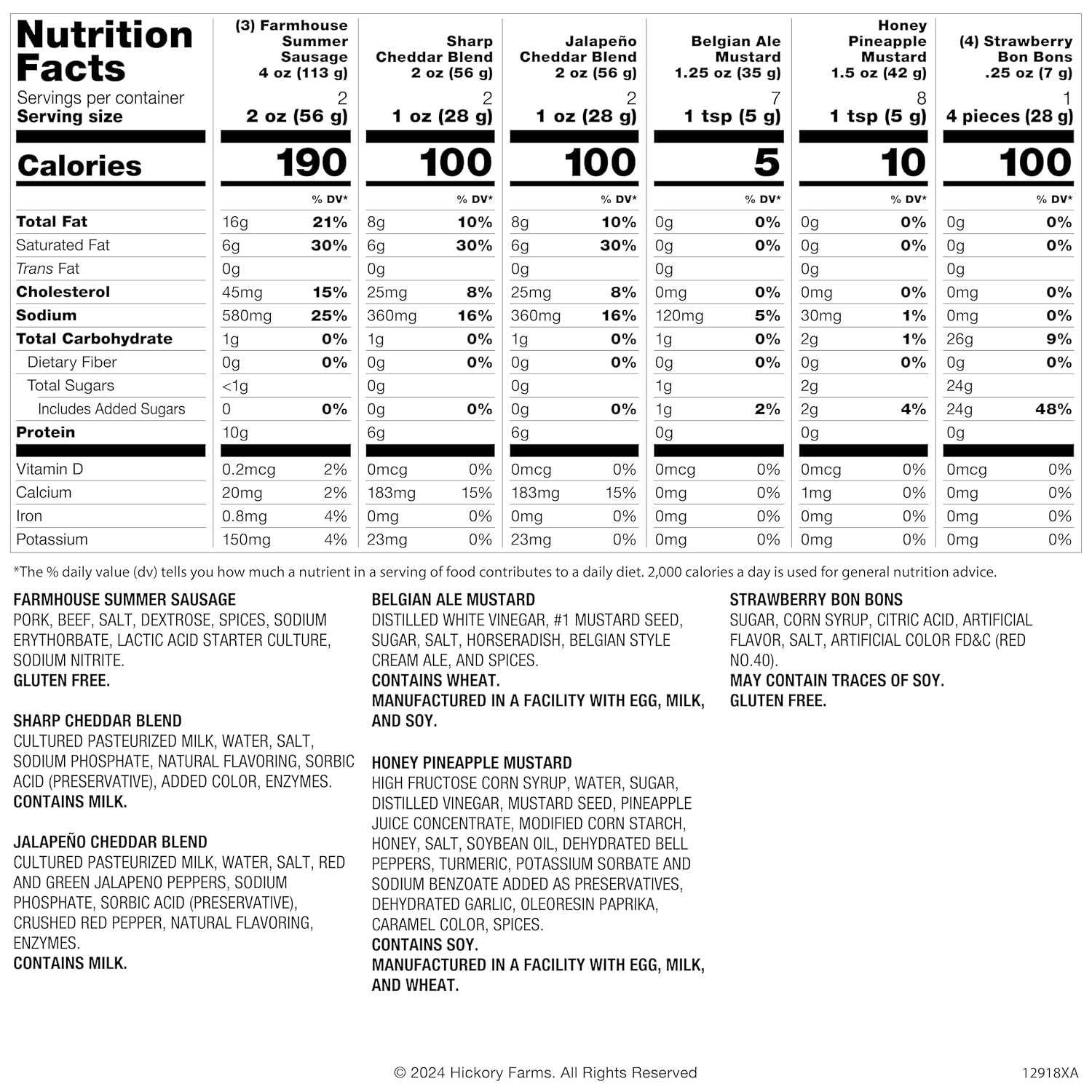
| EDITOR'S PICKHarry & David Supreme Meat And… | Mid-tier[Wisconsin Cheese Company - Ulti…](https://www.amazon.com/dp/B00JE0LEPW?tag=greenflower20-20) | Budget pick[Wisconsin Cheese Company – Gour…](https://www.amazon.com/dp/B0994V3KXV?tag=greenflower20-20) | |
|---|---|---|---|
| Crackers incl. | ✓ | ✓ | — |
| Mustard incl. | ✓ | ✓ | — |
| Sausage count | 4 | — | — |
| Cheese origin | — | 100% Wisconsin | 100% Wisconsin |
| Relish incl. | ✓ | — | — |
| Price | $123.98 | $74.99 | $34.19 |
| See on Amazon → | See on Amazon → | See on Amazon → |
The Four Tiers: What the Market Actually Looks Like in 2026
The meat-and-cheese basket market has consolidated around four recognizable price bands, each with its own sourcing logic and gifting use case. Here’s the honest lay of the land before we go tier by tier.
By the Numbers
| Tier | Price Range | Avg. Edible Weight | Named-Producer Cheeses | Corporate MOQ |
|---|---|---|---|---|
| Entry | $35–$65 | 10–16 oz | Rarely | None |
| Mid | $75–$120 | 18–28 oz | Sometimes | 12–25 units |
| Artisan | $125–$160 | 24–36 oz | Usually | 10–25 units |
| White-Glove | $200–$500+ | Custom | Always | 25–50 units |
Sources: product listing data aggregated from Harry & David, Hickory Farms, iGourmet, Zingerman’s, and Murray’s Cheese corporate program documentation, May 2026.
Tier One ($35–$65): Entry-Level Crowd-Pleasers — When They Work and When They Don’t
Harry & David and Hickory Farms own this tier, and they’ve earned their foothold: these are the baskets that show up reliably, survive the shipping gauntlet, and arrive looking presentable. Eater’s roundup of the best food gift baskets notes that Hickory Farms’ Summer Sausage and Cheese Gift Box consistently delivers on shelf-stable consistency — the meats are vacuum-sealed, the cheese is processed or semi-processed (meaning it’s been manufactured for uniformity, not aged for complexity), and the crackers are generic but functional.
What you’re actually buying here is logistics competence and brand recognition. The recipient knows the name. The box looks like a gift. Nothing is offensive.
What you are not buying: provenance. The cheese in a $45 basket is almost never named by creamery or region. It’s sourced for price stability, which means commodity cheddar, processed Swiss, and shelf-stable port wine cheese spread. The charcuterie — usually a summer sausage or beef stick — is made at scale by large processors. None of that is shameful. It just means the basket is a gesture, not a gastronomic statement.
When Tier One makes sense:
- Large-volume employee gifting with no per-unit personalization required (50+ units, $35–$50 spend)
- Recipient has dietary preferences you don’t know well enough to navigate (entry tiers are low-stakes)
- Supplementary gift — you’re pairing it with something else and the basket is backdrop
- The relationship is warm but not close-close; you want to show up without over-investing
When it doesn’t:
- The recipient is a food person. They will clock the commodity cheese.
- You’re trying to make a first impression in a new client relationship.
- The basket is the only thing you’re sending.
The honest verdict: Tier One is genuinely fine for what it is. The mistake is deploying it in a context that calls for something else.
Tier Two ($75–$120): Mid-Range Artisan — The Most Underrated Decision in This Category
This is where the market gets interesting and where most buyers leave value on the table by skipping straight to Tier Three or defaulting back to Tier One.
Retailers like iGourmet and Mouth.com have built their reputations in this band. iGourmet’s product listings document sourcing relationships with named American and European producers — you’ll see a Fiscalini Farmstead cheddar from California’s San Joaquin Valley, a Manchego with a DO (Denominación de Origen, meaning its production is regulated by geographic origin, like a wine appellation) sticker, or a Soppressata from a specific Italian-American cured meat house. Food & Wine’s basket roundup consistently flags iGourmet as the strongest mid-range value play precisely because the producer documentation is real, not marketing copy.
Goldbelly occupies a slightly different lane here: it functions as a marketplace rather than a house curator, so quality varies by vendor, but the top-performing vendors on the platform (small regional cheesemakers, boutique charcuterie producers) offer baskets in the $85–$115 range that punch well above their price.
What changes at this tier:
- Edible-to-filler ratio improves materially. At $45, you might have four ounces of actual cheese surrounded by tissue paper, a decorative tin, and a ribbon. At $95, you’re more likely to have 20–26 ounces of actual edibles. Serious Eats’ guidance on cheese board kits emphasizes exactly this: weight the edible content, not the packaging footprint.
- Aging matters now. A six-month aged Gouda behaves differently on a palate — it’s crystalline, nutty, caramel-adjacent — than a young processed Gouda. At Tier Two, you start seeing real affinage.
- The charcuterie gets interesting. Dry coppa, fennel salami, or a proper Calabrian soppressata replaces summer sausage. These are made by smaller processors using traditional curing methods.
The tradeoff to name explicitly: Shipping reliability is more variable at this tier. iGourmet ships with ice packs and insulated liners and has a strong track record, but smaller Goldbelly vendors vary. If you’re ordering during peak holiday weeks (mid-November through December 24), add two to three days of buffer or pay for expedited shipping. The cheese is real now — it can turn.
Corporate context: Most mid-range artisan retailers will accommodate orders of 12–25 units with advance notice, but branded packaging (your logo, a custom note card printed on your letterhead) is inconsistent. Some offer it; most don’t at this tier. If branding matters, you’re looking at Tier Three.
Tier Three ($125–$160): Artisan-Premium — The Sweet Spot for Relationship Gifting
This is the tier that closes client relationships and gets remembered at the holiday party. Zingerman’s hand-packed collections and Murray’s Cheese curated baskets both operate comfortably here, and both do something important: they tell you exactly what’s inside and why.
Zingerman’s product documentation — which is unusually transparent by industry standards — names every producer, notes the region of origin, and explains why each item was selected. A basket at $145 might include a Neal’s Yard Dairy Montgomery’s Cheddar (a raw-milk farmhouse cheddar from Somerset, England, considered one of the world’s great cheddars), a domestic prosciutto from La Quercia in Iowa (known for heritage-breed Berkshire pork and long-cure programs), and a locally made pepper jelly. Each of those choices has a story. That story is what the recipient experiences when they open the box.
Murray’s Cheese, per their corporate gifting program guide, offers white-label branding at this tier for orders of 25+ units — custom belly bands, branded tissue, personalized note cards. Their cave-aging program (Murray’s operates its own aging caves in Long Island City, New York, where temperature and humidity are controlled to finish cheeses to spec) means some of the product in their curated baskets has been through their own affinage process. That’s a meaningful differentiator.
What you’re paying for at Tier Three:
- Documented provenance on every major item
- Real affinage — cheese that’s been aged to a deliberate flavor profile, not just held
- Packaging that reads as premium without being ostentatious
- Branding options for corporate use
- Curatorial intelligence: someone made intentional pairing decisions
The honest tradeoff: At $145, you are paying a meaningful premium for story and curation. If your recipient doesn’t engage with food at that level — if they’ll eat the cheese happily without reading the card — you may be over-investing. Know your audience.
Tier Four ($200–$500+): White-Glove Corporate Programs — A Different Purchase Entirely
Cowgirl Creamery’s cave-aged selections, Murray’s custom corporate builds, and Zingerman’s large-format bespoke packages operate here. This tier is not a bigger version of Tier Three. It’s a different product category with a different decision framework.
At $200–$500 per unit, you are buying:
- Program management. A dedicated account contact, order tracking, coordinated delivery windows, and replacement fulfillment when something arrives damaged. This is the operational infrastructure that corporate procurement requires.
- Brand integration. Custom boxes, logo embossing, handwritten notes at scale, branded inserts.
- Consistency at volume. The 50th basket looks like the first basket. This is not trivial.
- Provenance at maximum depth. A $350 Murray’s custom build might include a single-estate Comté aged 24 months, a whole cured leg of prosciutto from a specific farm, and a hand-labeled cave-aged selection. The documentation is gift-ready.
Per Murray’s corporate gifting program documentation, minimum order quantities for white-glove programs typically start at 25 units with 3–4 weeks lead time for custom branding. True landed cost — the per-unit price including shipping, cold-pack surcharges, and any custom packaging fees — typically runs 15–25% above the listed basket price for deliveries outside major metro areas.
Eater’s 2025 gifting roundup flags this as the most common miscalculation in corporate gifting: buyers budget the basket price and forget the logistics tail.
The Decision Rule: If X, Then Y
If your budget is under $65 and the relationship is warm-but-not-close, Tier One is genuinely appropriate. Don’t let anyone shame you out of it.
If your budget is $75–$120 and you want the basket to mean something without the corporate infrastructure conversation, iGourmet or a vetted Goldbelly vendor is your move. It’s the most underdeployed tier in the market.
If you’re gifting a food-engaged recipient, a new client you want to impress, or a small cohort (under 25 units) where personalization matters, Tier Three is your floor. Zingerman’s or Murray’s. Budget $135–$160 per unit plus shipping.
If you’re running a 25-to-100-unit corporate program and brand consistency is non-negotiable, get on the phone with Murray’s or Zingerman’s corporate accounts before you finalize any budget. Lead time, minimum quantities, and branding specs will drive your decision more than the per-unit price — and true landed cost will be higher than the basket price suggests.
The basket tier is the easy decision. The harder one is matching tier to relationship, context, and logistics reality. Get that right and the rest follows.